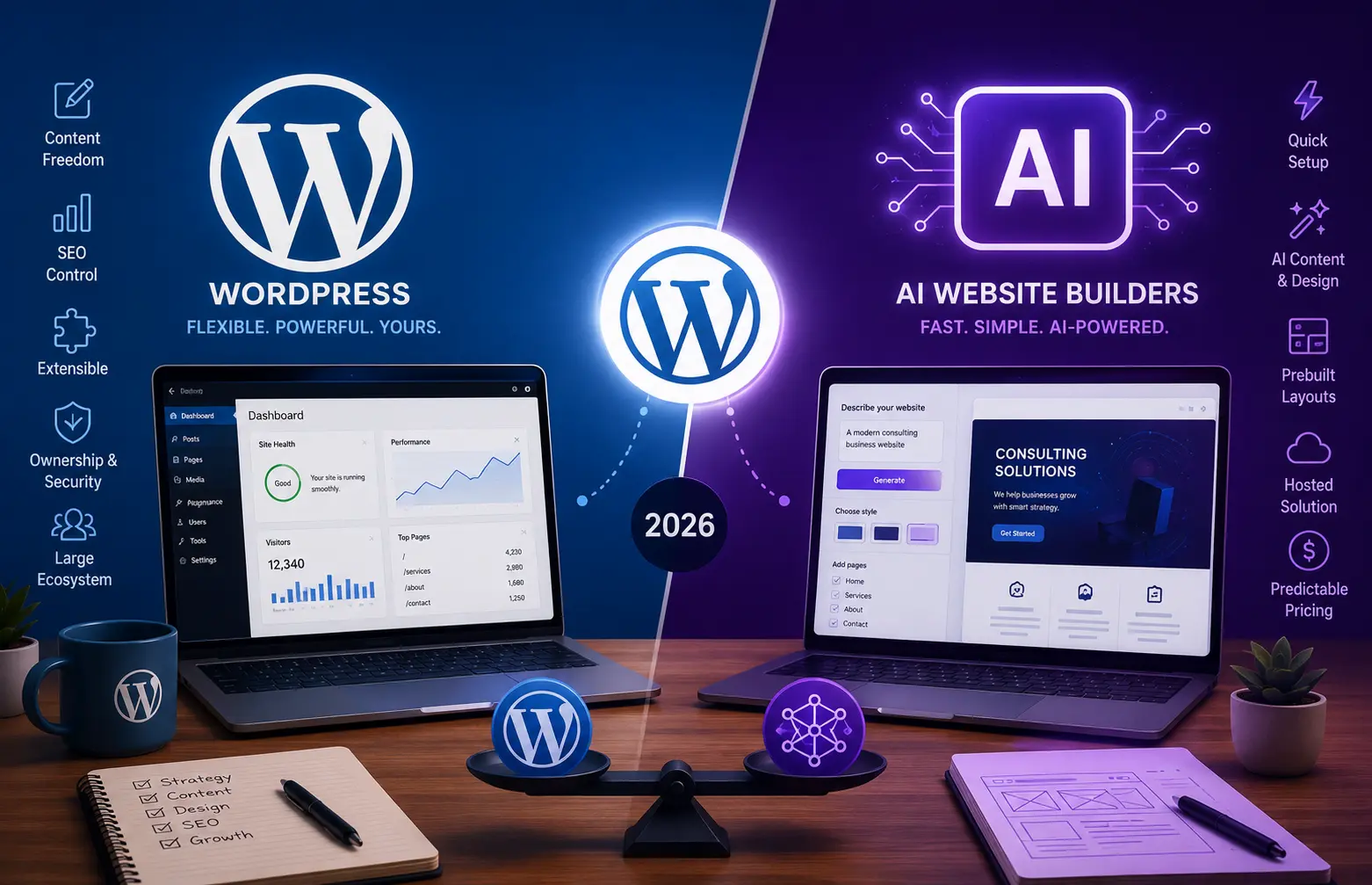

Many business owners hear the same question again and again: “Is WordPress still relevant, or should I just use an AI website builder?”
It is a fair question. AI tools can now create page drafts, suggest layouts, write website copy, generate images, and help people launch simple websites faster than before. That has changed expectations. A business owner who once expected a website project to take months may now wonder why it cannot start with a prompt.
But popularity and usefulness are not the same thing. A platform can be popular but not right for every project. It can also face new competition and still remain a very strong choice.
So, is WordPress still popular in 2026? Yes. The latest public data still shows WordPress as the dominant content management system. But the more useful answer is slightly more balanced: WordPress is still a smart choice for many business websites, especially when flexibility, ownership, SEO, content, and long-term growth matter.
Table of Contents
- WordPress market share in 2026
- How WordPress usage compares with previous years
- Why businesses still use WordPress
- How AI website builders are changing expectations
- How AI can make WordPress development faster
- Where WordPress is still stronger than simple AI website builders
- Where WordPress may not be the best choice
- What small businesses should consider before choosing
- Is WordPress still a smart choice in 2026?
- FAQ
WordPress market share in 2026
The latest available W3Techs data, updated on 2 June 2026, shows that WordPress is used by 59.4% of all websites whose content management system is known. That equals 41.9% of all websites measured by W3Techs. Source: W3Techs
That is still a very large share of the web.
Another way to look at popularity is the number of live websites. BuiltWith reports 37,365,862 live websites using WordPress, based on its WordPress usage data. Source: BuiltWith
These numbers do not mean every business should automatically choose WordPress. They do show that WordPress is not disappearing. It remains one of the main foundations of the modern web.
How WordPress usage compares with previous years
WordPress grew strongly for many years, then reached a more mature stage.
According to W3Techs historical yearly usage data, WordPress was used by 23.3% of all websites in January 2015, 35.4% in January 2020, 43.2% in January 2022, 43.6% in January 2025, 43.0% in January 2026, and 41.9% on 2 June 2026. Source: W3Techs
This tells us two useful things.
- WordPress is still much larger than any other content management system.
- Its overall share has softened slightly after several years around the low 40% range.
That slight decline should not be ignored, but it also should not be exaggerated. Mature platforms often stop growing quickly once they already have a very large share. The web is also more fragmented now. There are hosted website builders, ecommerce platforms, no-code tools, landing page tools, AI builders, and custom application platforms.
For comparison, W3Techs reported on 2 June 2026 that Shopify had 7.4% of the known CMS market, Wix had 6.1%, and Squarespace had 3.5%. WordPress was still at 59.4% of the known CMS market. Source: W3Techs
So the short version is simple: WordPress is not growing like it did ten years ago, but it is still far ahead of the nearest alternatives.
Why businesses still use WordPress
Most small businesses do not choose a website platform because of market share charts. They choose a platform because it helps them solve real problems.
WordPress is still widely used because it fits many business needs:
- Content control: Businesses can publish service pages, blog articles, case studies, landing pages, resources, and updates without rebuilding the whole site.
- SEO flexibility: WordPress gives developers and site owners control over page structure, metadata, internal links, schema, performance work, redirects, and content organization.
- Ownership: With self-hosted WordPress, the business has more control over hosting, files, database, backups, and future migration.
- Extensibility: A simple site can grow into a larger content hub, membership area, booking system, multilingual site, or WooCommerce store.
- Large ecosystem: There are many developers, agencies, plugins, themes, hosting companies, and learning resources around WordPress.
The ecosystem is still active. WordPress.org lists over 14,000 free themes in its official theme directory. Source: WordPress.org
There is also visible activity in plugin development. The WordPress Plugins Team reported that plugin submissions were typically around 100 to 150 per week in previous years, rose above 300 per week by the end of 2025, and exceeded 500 weekly submissions by March 2026. Source: Make WordPress Plugins
For a business owner, this matters because an active platform is easier to support. You are more likely to find developers, integrations, documentation, and long-term help.
How AI website builders are changing expectations
AI website builders are not just another design trend. They are changing what people expect from the website creation process.
A business owner can now describe a business, choose a tone, add a few services, and get a starting website draft quickly. That is useful. It can reduce the blank-page problem, especially for very small businesses that need a simple online presence.
AI tools can help with:
- first drafts of page copy
- basic website structure
- layout suggestions
- image ideas
- simple landing pages
- early content planning
This is why WordPress cannot rely only on its history. People now expect website projects to start faster, feel easier, and involve less manual repetitive work.
But speed at the beginning is only one part of the website decision.
A website also needs to be clear, trustworthy, easy to update, fast on mobile, understandable for Google, secure, and aligned with the business. AI can help with many of those steps, but it does not automatically make good strategic decisions.
How AI can make WordPress development faster
AI is often presented as a threat to WordPress. In practice, it can also make WordPress work better and faster.
For a developer or website consultant, AI can support the process in practical ways:
- planning page structures
- creating first drafts of content briefs
- summarizing competitor pages
- checking content clarity
- generating simple code snippets for review
- speeding up testing and troubleshooting
- writing documentation for clients
- creating reusable workflow checklists
This does not remove the need for professional judgment. It simply reduces repetitive work.
For example, AI can draft a first version of a service page. A good website professional can then improve the message, match it to real search intent, structure it for SEO, connect it to the right call to action, and make sure it fits the business.
That combination is where WordPress can remain very strong: AI helps with speed, while WordPress provides a flexible system for building, publishing, optimizing, and growing the website over time.
Where WordPress is still stronger than simple AI website builders
Simple AI website builders can be helpful for quick projects, but WordPress is often stronger when the website is more than a digital business card.
Content and SEO growth
If a business plans to publish articles, service pages, location pages, resources, comparisons, FAQs, and case studies, WordPress is still one of the strongest options. It gives more control over content structure, internal linking, categories, custom fields, and technical SEO.
Custom design and functionality
Many businesses eventually need something specific: a custom quote form, integration with a CRM, advanced filtering, multilingual content, booking logic, ecommerce features, client portals, or custom post types.
Simple AI builders may handle the first version of a website well, but they can become limiting when the website needs to match a real business process.
Ownership and portability
With self-hosted WordPress, the business is not locked into one closed website builder in the same way. Hosting can be changed. Developers can be changed. The site can be extended. Data can be backed up and moved more easily.
This matters when the website becomes a serious business asset.
A bigger professional ecosystem
Because WordPress is so widely used, it is easier to find people who can work on it. That includes developers, SEO specialists, content teams, maintenance providers, hosting companies, and plugin developers.
For a small business, this reduces long-term risk. You are not dependent on one tool, one vendor, or one closed system.
Where WordPress may not be the best choice
A balanced answer should also say where WordPress may not be the right fit.
WordPress may be too much if you only need a very small website with a few static pages and no growth plan. In that case, a simple hosted builder may be easier.
WordPress may also be the wrong choice if nobody will maintain it. A neglected WordPress website can become slow, outdated, or vulnerable. Plugins, themes, backups, security, hosting, and performance all need attention.
For some ecommerce businesses, Shopify may be a better fit, especially when the main need is a managed online store with less technical responsibility.
For design-heavy landing pages or startup marketing sites, platforms like Webflow or Framer may also make sense, depending on the team and workflow.
The right question is not “Is WordPress popular?” The better question is “Does WordPress fit the business goal, budget, content plan, and maintenance reality?”
What small businesses should consider before choosing
Before choosing WordPress, an AI website builder, or another platform, a small business should answer a few practical questions.
How important is SEO?
If organic search is important, you need more than a nice homepage. You need clear page structure, useful content, fast loading, proper metadata, internal links, and room to grow. WordPress is often a strong choice for that.
Will the website grow?
A five-page website today may become a content hub, lead generation system, ecommerce store, course platform, or multilingual website later. If growth is likely, WordPress gives more flexibility.
Who will maintain it?
A WordPress website should not be built and forgotten. Someone needs to handle updates, backups, security checks, plugin reviews, and performance monitoring.
How custom does the website need to be?
If the business has unique services, content types, integrations, or workflows, WordPress can be shaped around the business more easily than many simple builders.
Is speed more important than control?
Sometimes the fastest option is the right option. If a business needs a temporary landing page, event page, or simple proof of concept, an AI builder may be enough.
But if the website is expected to support the business for years, control and flexibility become more important.
Is WordPress still a smart choice in 2026?
Yes, WordPress is still a smart choice in 2026 for many small and medium businesses.
The numbers show that WordPress remains the most widely used content management system by a large margin. The ecosystem is still active. The platform is flexible. Developers are still building for it. Businesses still rely on it for content, SEO, lead generation, ecommerce, and long-term website growth.
At the same time, WordPress is no longer the automatic answer for every website.
AI website builders are useful. They are raising expectations. They can help businesses move faster, especially at the beginning of a project. They are also pushing WordPress professionals to work smarter, communicate more clearly, and remove unnecessary complexity.
The strongest approach is not WordPress versus AI. It is WordPress with better planning, better tools, and smarter workflows.
For a business that wants a quick, simple online presence, an AI website builder may be enough. For a business that wants a flexible website it can own, improve, optimize, and grow over time, WordPress is still very relevant.
A good website decision should not start with hype. It should start with the business goal, the content plan, the maintenance plan, and the level of control the business needs.
FAQ
Is WordPress still popular in 2026?
Yes. W3Techs reported on 2 June 2026 that WordPress was used by 59.4% of websites with a known content management system and 41.9% of all websites. Source: W3Techs
Is WordPress losing market share?
WordPress has softened slightly from its recent high. W3Techs historical yearly data shows WordPress at 43.6% of all websites in January 2025, 43.0% in January 2026, and 41.9% on 2 June 2026. Source: W3Techs
Are AI website builders better than WordPress?
Not always. AI website builders can be very useful for quick, simple websites. WordPress is usually stronger when a business needs content growth, SEO control, custom functionality, integrations, ownership, and long-term flexibility.
Can AI be used with WordPress?
Yes. AI can help with planning, content drafts, code assistance, testing, documentation, and workflow improvements. The best results still need human review, business judgment, and proper website strategy.
Should a small business choose WordPress in 2026?
WordPress is a good choice if the business wants control, flexibility, SEO growth, and a website that can evolve. A simpler website builder may be better for a very small website with limited needs and no maintenance plan.